.svg)
MuMo - Centre Pompidou
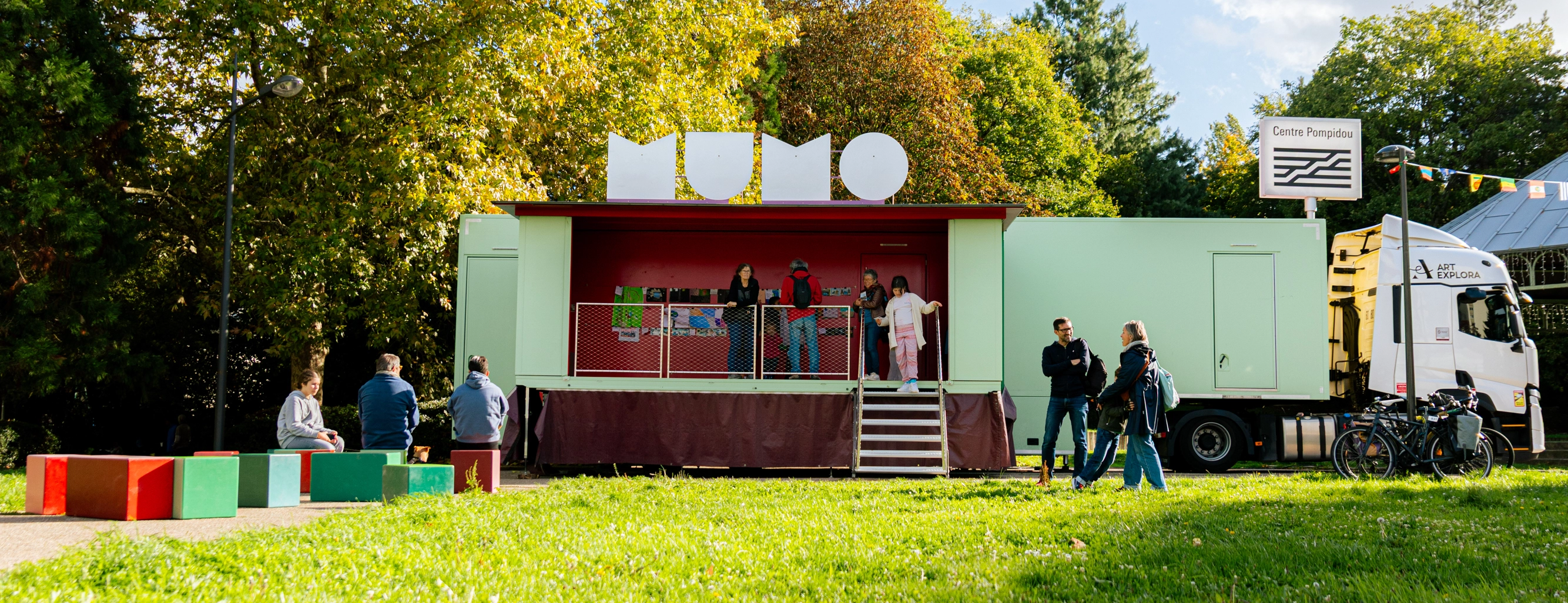
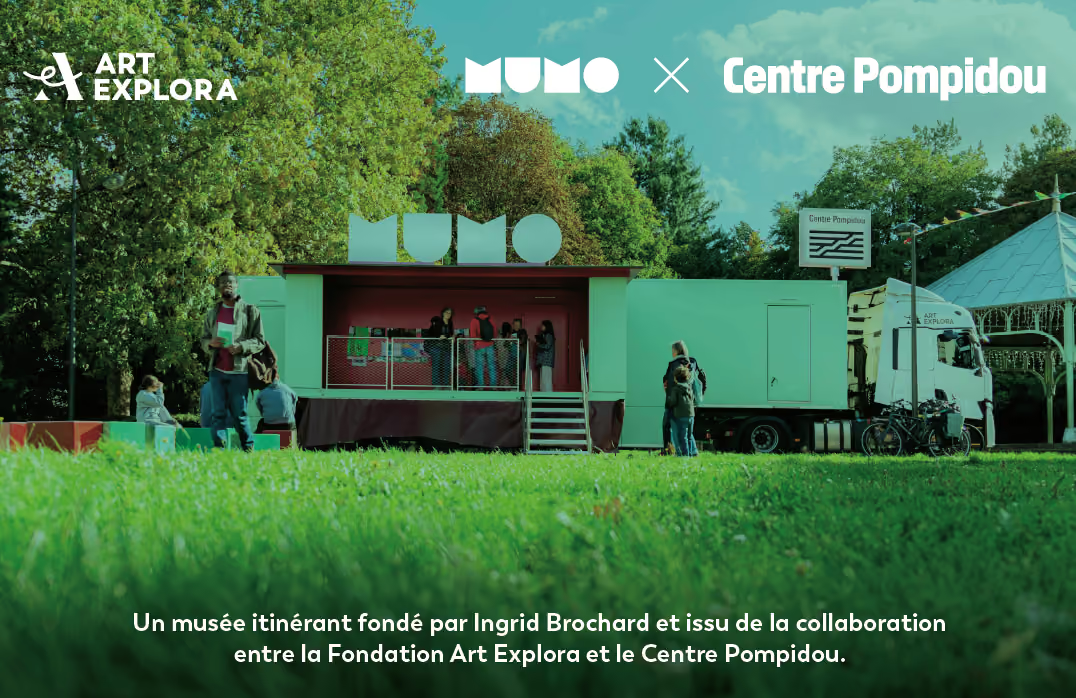
Since 2022, the MuMo - Centre Pompidou museum truck has been travelling the roads of France, visiting local residents with works of modern and contemporary art from the Centre Pompidou.
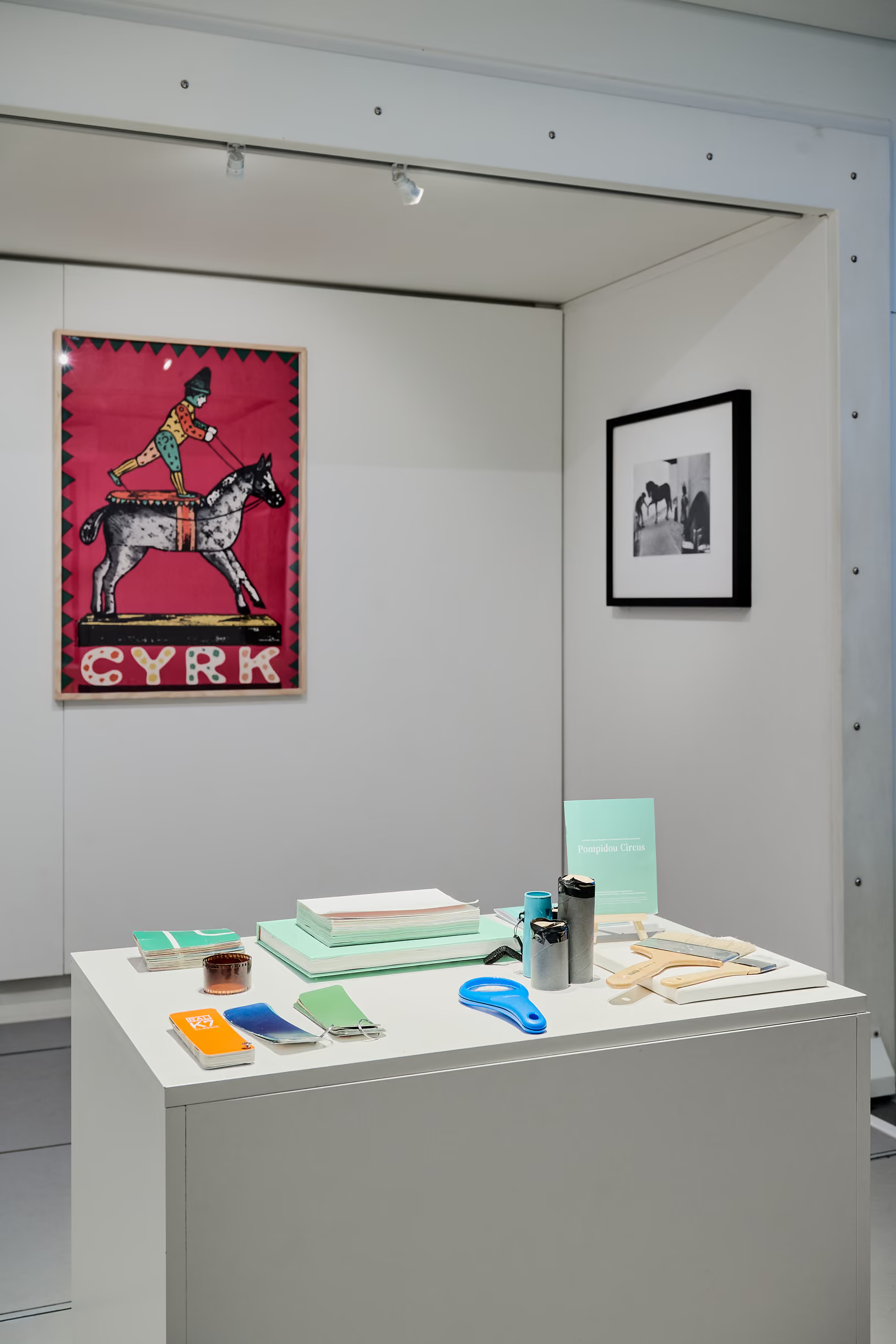
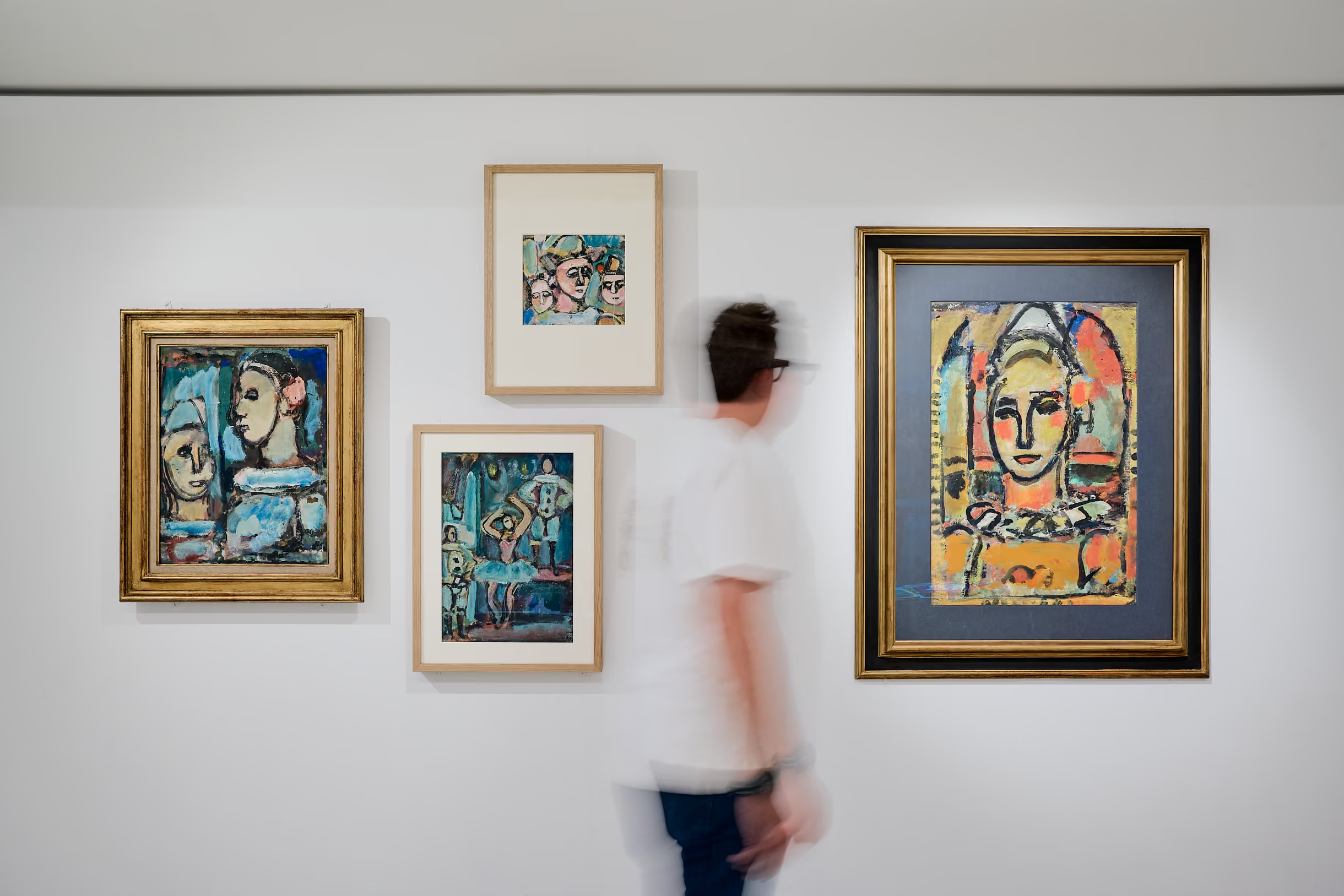
"Pompidou Circus" Exhibition in the Centre-Val de Loire Region and the Paris-Saclay Metropolitan Area
An exhibition curated by Anne Lemonnier, Curator of Modern Collections at the Centre Pompidou – National Museum of Modern Art.
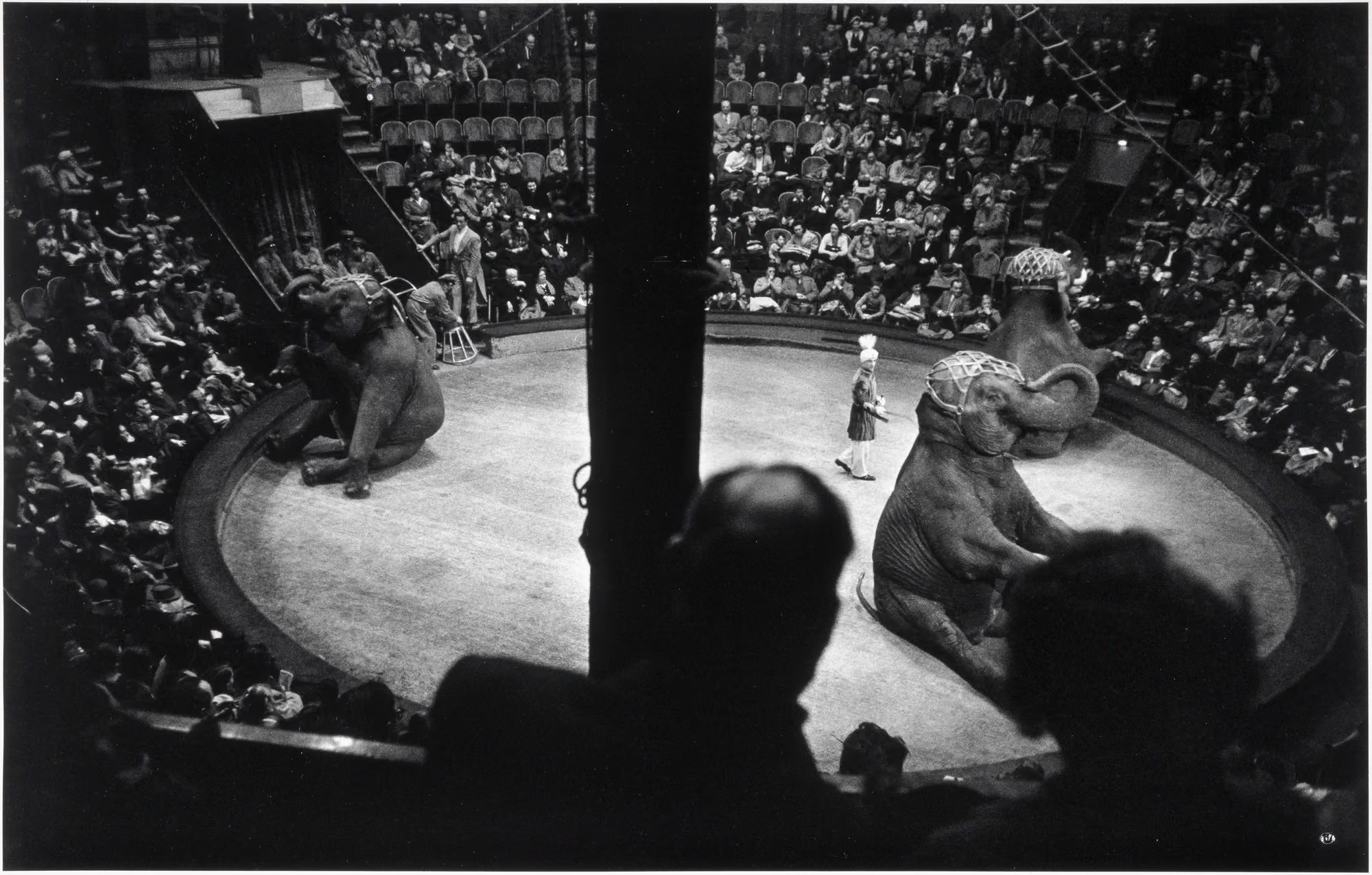
"Mobile museum, traveling exhibition": how can we not think of traveling artists, carnival performers, and circus performers? Always hitting the road, setting up camp for just a few days: the circus chooses the ephemeral as a way of life and infinity as its horizon. As for the audience, thanks to a makeshift show, they let their thoughts drift; they abandon their postures, their certainties, and their discourse at the cloakroom. What is happening in the ring takes them elsewhere. To a land of strangeness and childhood, of laughter and dreams. Somewhere between reality and illusion, between the obvious and the fantastical.
The world of the circus and that of the artistic avant-garde of Montmartre in the 1900s were closely linked. The Medrano circus pitched its big top at the foot of the hill, and many painters frequented it. But rather than the lights of the ring, it was the other side of the curtain that they depicted: poverty, loneliness, and wandering. They thus placed themselves in a poetic tradition, that of Charles Baudelaire, whose writing is inhabited by the figures of the vagabond and the street performer, whom he calls "the prophetic tribe with burning eyes" ("Bohemians on the Road," Les Fleurs du mal). Guillaume Apollinaire developed this melancholic vein in his wake, with his harlequins "brushed by the shadows of the dead," guides to the afterlife ("Crépuscule," Alcools). A marginal character by definition, somewhere between the sublime and the grotesque, enchanting and clownish, the clown is often perceived by artists as an alter ego.
“The choice of the clown as an image is not merely the selection of a pictorial or poetic motif, but a roundabout and parodic way of posing the question of art. […]. The critique of conventional respectability is coupled here with a self-critique directed against the aesthetic vocation itself. We must recognize in this one of the characteristic components of ‘modernity’ over the past little more than a century.”
Jean Starobinski, Portrait of the Artist as a Street Performer(1970)
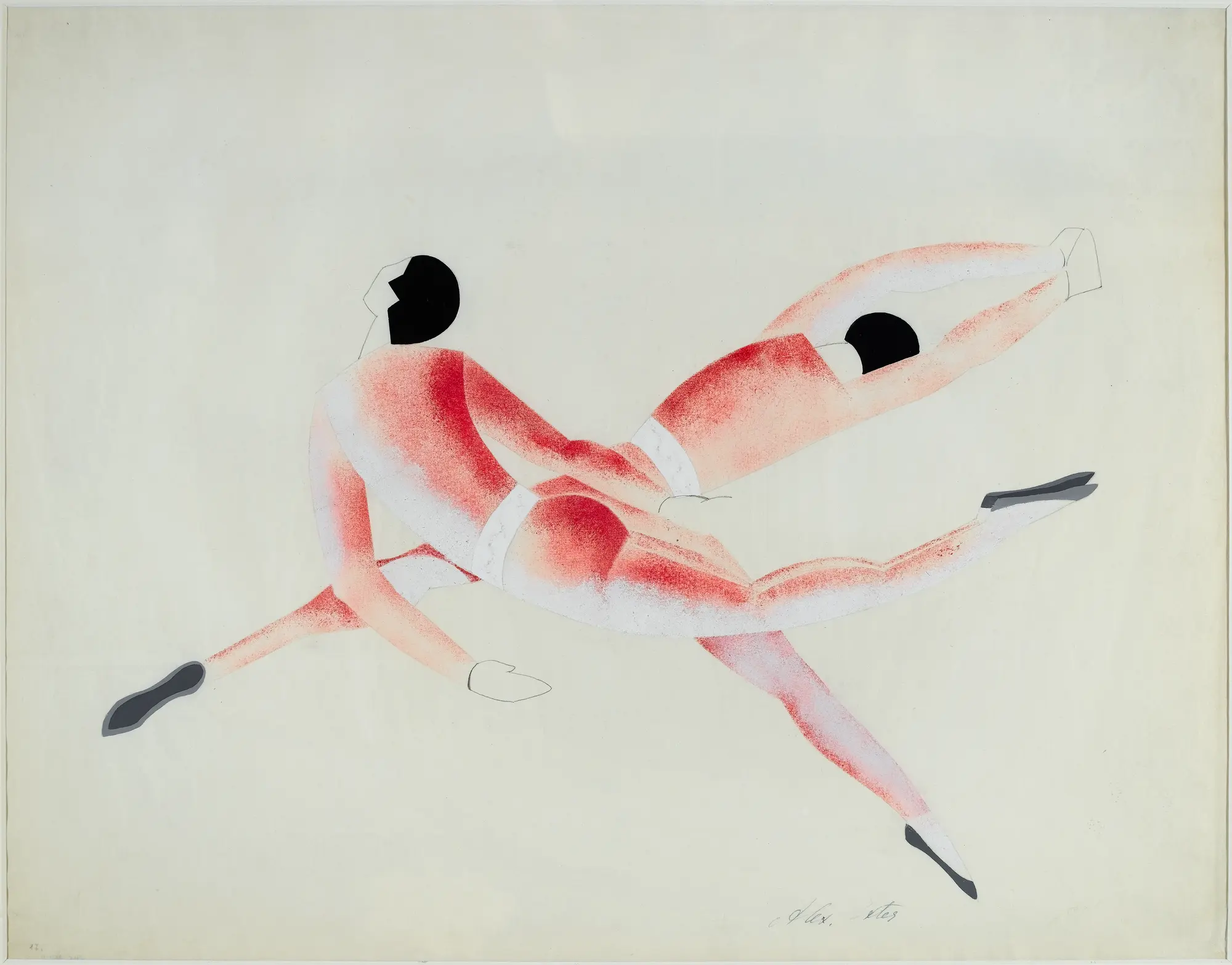
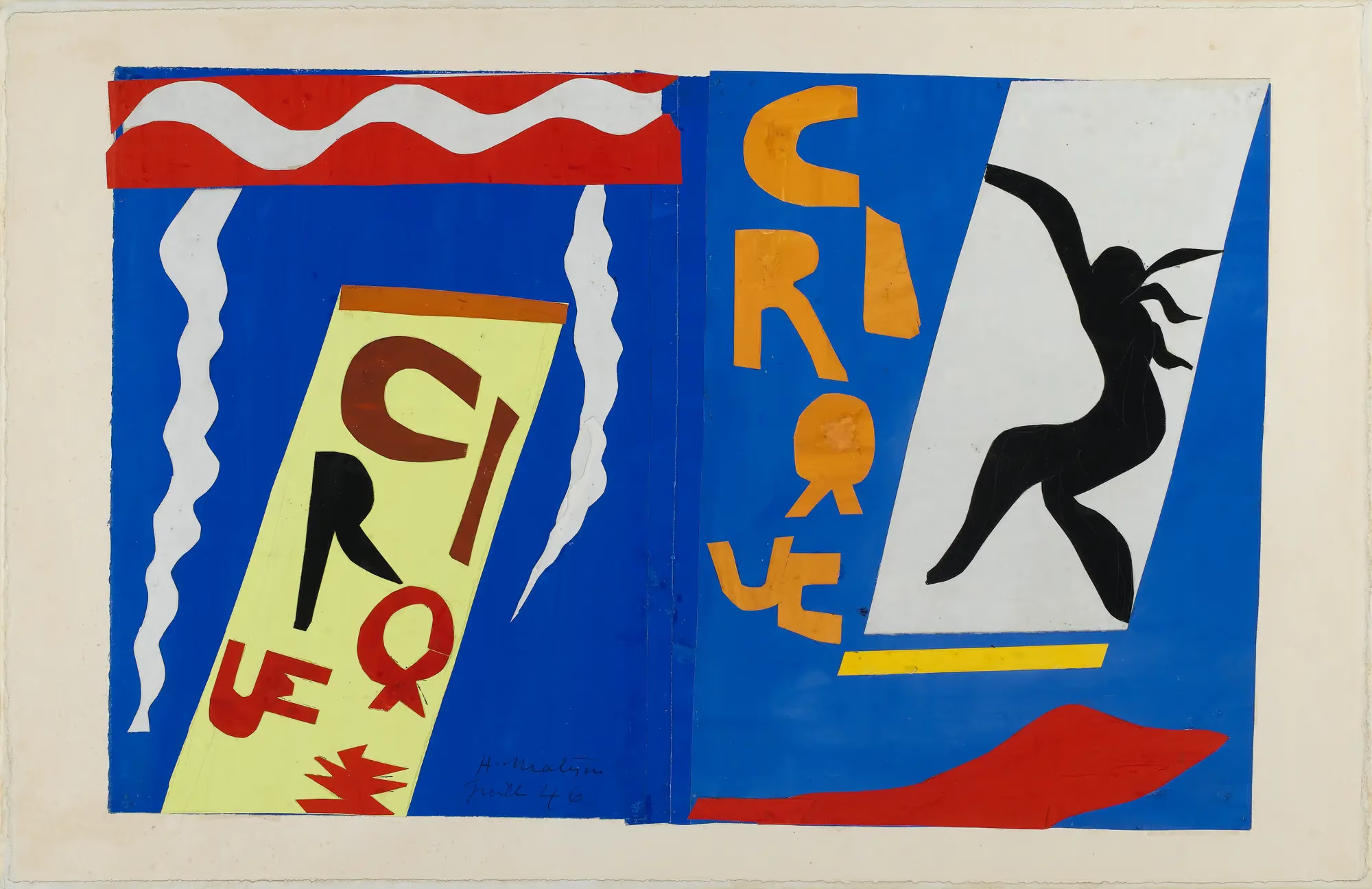
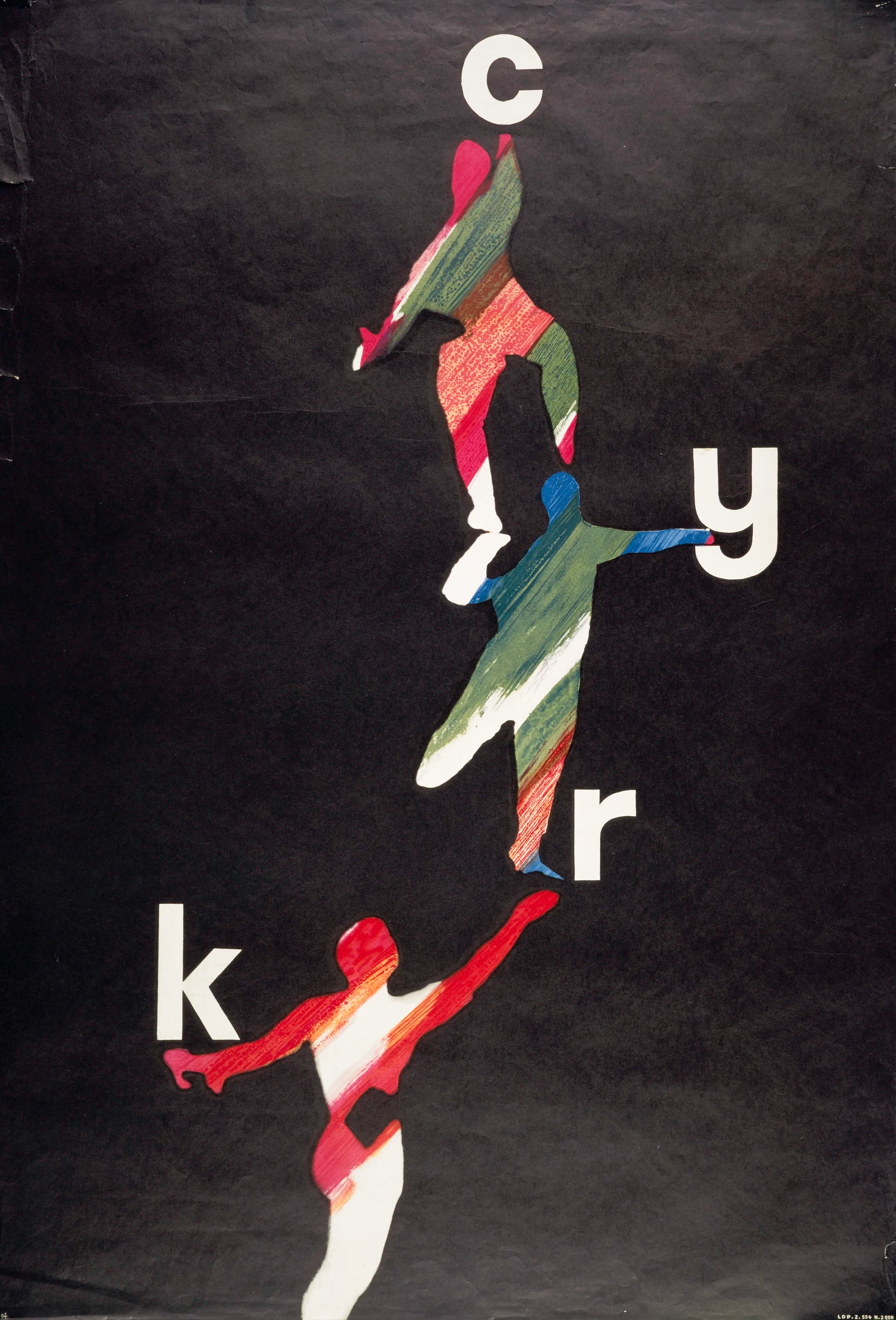
Alongside the clown, a wild animal trainer, a sword swallower, a magician, horseback riders, and jugglers take to the ring… Among this procession of colorful characters, the acrobat is a favorite subject. Whether the artists work with cut-out gouaches, like Henri Matisse, or paint with a lively brushstroke, like Raoul Dufy, their aim is to capture the energy, flexibility, and virtuosity of bodies moving through space. In these works, forms twist and untwist, emerge and transform. And in Roman Cieslewicz’s posters on black backgrounds, the acrobats, launched into space and captured by a ray of light, become pure graphic symbols, dazzling in the darkness.
“But tell me, who are these wanderers, even more fleeting than we ourselves? For whose sake does an insatiable will drive them and urge them on so early? It wrings them out, twists them, embraces them, and hurls them; it casts them away and catches them again. And they fall back, smooth and slippery, onto the carpet worn thin by their endless leaping, a carpet lost in the universe […]. Ah, and around this center, the rose of the gaze blooms and sheds its petals.”
Rainer Maria Rilke, The Fifth Duino Elegy(1922)
Anne Lemonnier, Curatorial Assistant, Modern Collections, Centre Pompidou – National Museum of Modern Art
Discover all the works on display in the exhibition catalog!
Photos
.avif)
Itinerary
.webp)
Will a truck be passing through my area soon?

The resources


Presentation of the museum-truck
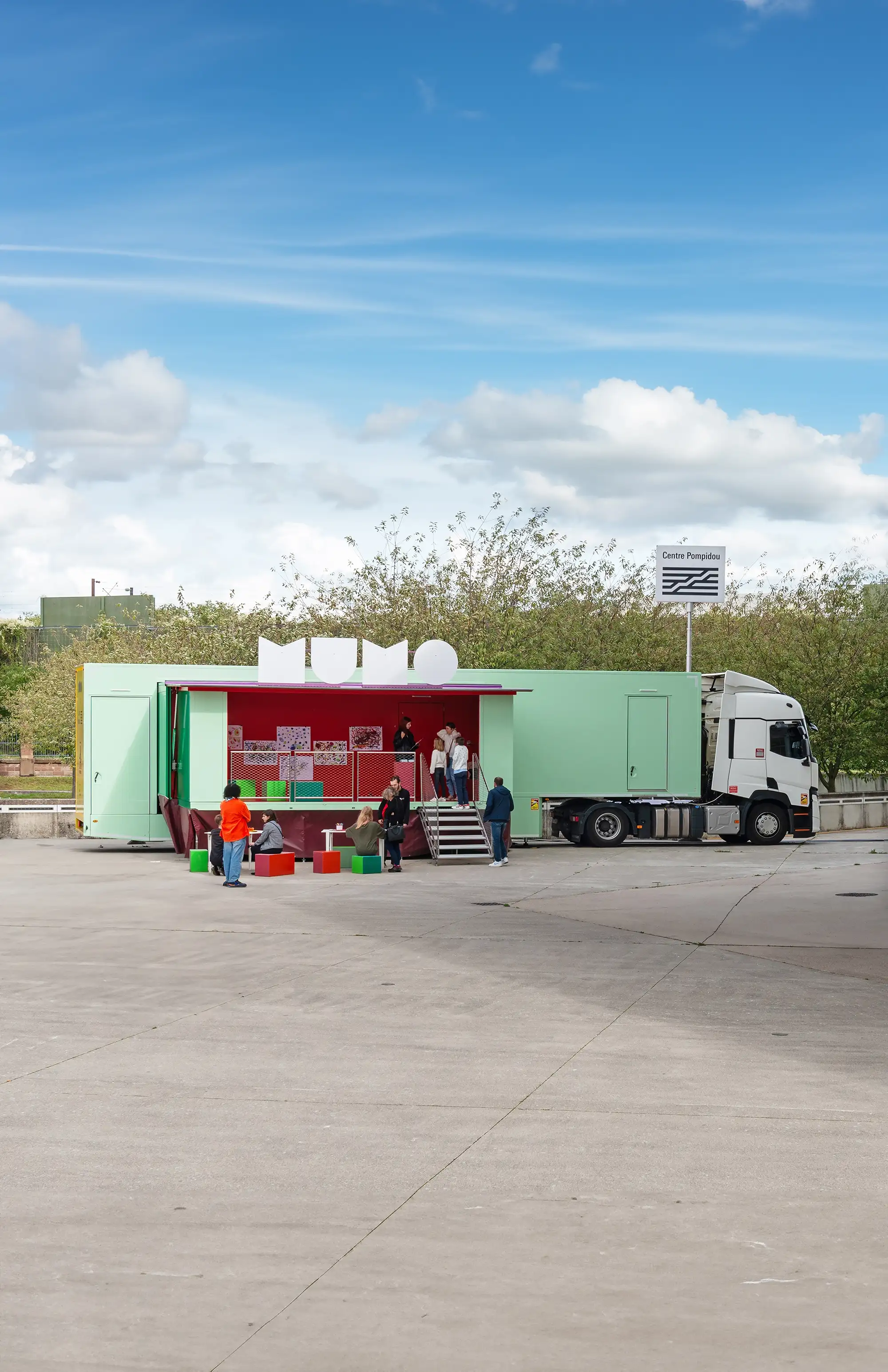
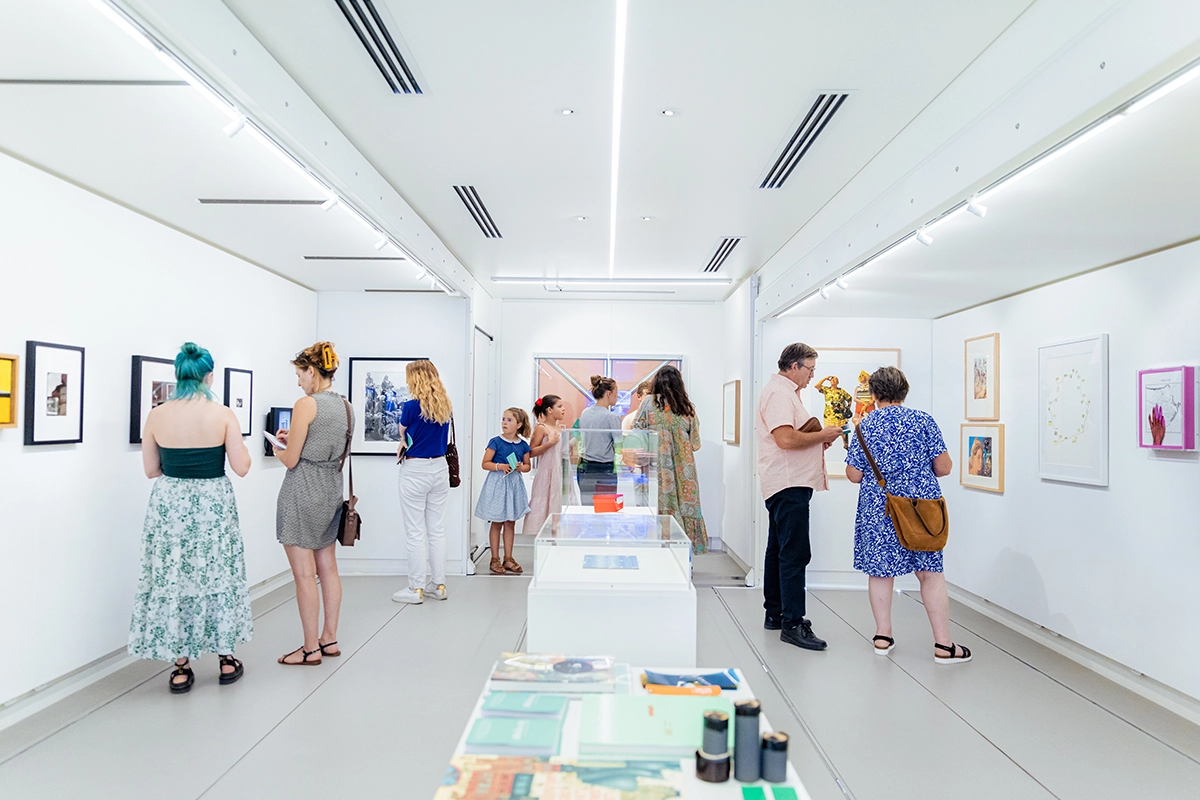
This collaboration leaves plenty of room for the works on display. The truck was imagined as a multifunctional tool, simple and adaptable to different uses around three spaces: the loggia, the exhibition room and the alcove. The loggia opens out like a theater stage to welcome the public. The exhibition room is the heart of the installation, a streamlined space in which technical elements are hidden to avoid visual disturbance of the works. The alcove is the raised space extending from the exhibition room. It can be a projection room with seating, a place for sculptures or a work of art in itself, imagined by Krijn de Koning.


Designer interviews
How did you go about designing the museum truck for the Centre Pompidou?
Isabel Hérault: We approached this project from two angles. The first concerned its technical aspects: we considered all the possibilities offered by the truck, which led us to study the operation of different types of existing truck (fire department, Tour de France, etc.).
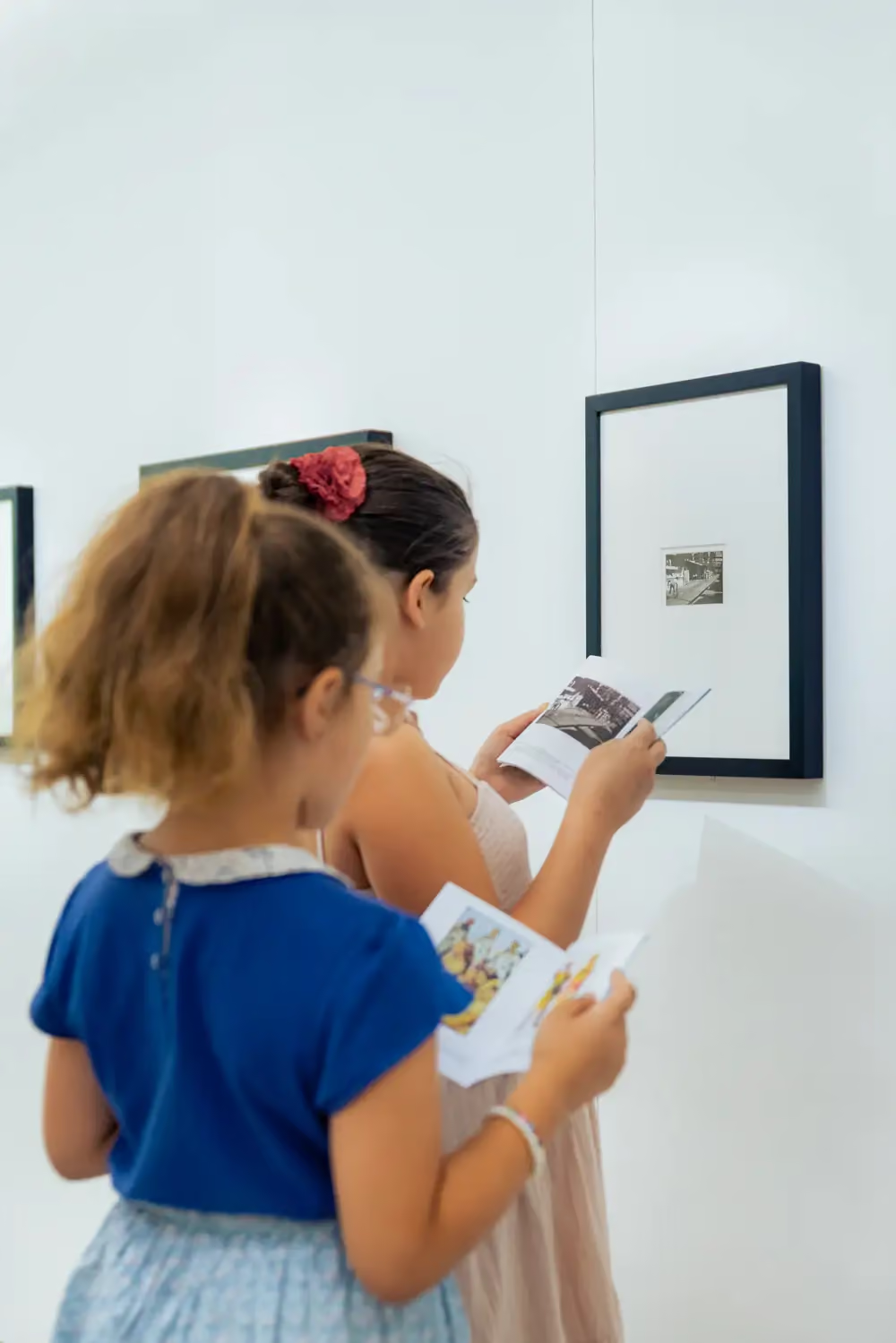
The second focus was on the functionalities of a museum truck: how to turn it into a "real" museum, despite its small surface area, while taking into account the specific features of the Centre Pompidou's offering from the outset, notably its multi-disciplinarity? We wanted the truck's hanging space to be as close as possible to the characteristics of a museum space, so as to present the works in optimum conditions: the exhibition room is white and uncluttered, the technical elements are hidden, and the works are hung on the walls without any visible fixtures. The technical elements disappear in favor of the works.
Recognizing that the Centre Pompidou is much more than just an exhibition space, we also wanted to create a small-scale setting for performances, concerts, film screenings and children's workshops.
I'd like to talk about the loggia, which is one of the highlights of the project...
I.H.: The loggia is primarily designed as a reception area, a buffer space that protects the museum from the outside world. (...) It is reminiscent of a revisited trade fair stand, both attractive and cheerful, with the sign above and the red color creating a focal point. It has very pragmatic functionalities, with checkrooms on either side so you can leave your coat on. For us, the mere fact of taking off your coat before entering the exhibition room brings us closer to museum conditions (at least in terms of how it feels). In winter, this space is closed by a translucent curtain that lets in light and insulates it from cold and damp. The loggia serves as a mediation space, where children's workshops can be organized and their work hung. Films can also be projected from the loggia. It's an adjoining space that can be used for all purposes not related to the exhibition.
You're working on this project with visual artist Krijn de Koning. How do you go about it?
I.H.: (...) This collaboration with Krijn de Koning was defined right from the start of the project: Hérault Arnod worked on the general design of the museum truck, while Krijn de Koning was in charge of the MuMo's color and furniture. This corresponds to the field of his work as a visual artist, whose work addresses the issues of color, volume and interaction with architecture. (...)
Krijn de Koning: As Isabel says, I concentrated on color, which is present both inside and outside the truck, and I also worked on blocks that can be used as seats or small tables. These blocks also have an aesthetic purpose when arranged against the alcove wall: they form a colorful composition and interact with the truck's environment.
Your various projects involve a multiplicity of architectural "situations" (historic buildings, domestic spaces, art galleries and museums, gardens, etc.), and color is often an integral part of this reflection. What role does it play in your projects, given that you've sometimes referred to it as a visual tool?
K.d.K.: The use of color is a way of drawing the eye and attention to the reality that surrounds us, and in this respect, color can be said to be a visual tool. I always find it fascinating that an architectural space can radically change its status and offer a totally different perception thanks to a thin layer of colored paint.






.avif)


.avif)

%20(1).avif)








.avif)